
The optimal temperature for keeping meat, fruits and vegetables

Correct temperature and humidity for food stored in cold rooms
Cold rooms, broadly speaking, can be categorized in freezing rooms (with negative temperatures) and refrigerating rooms (with slightly positive temperatures).
In order to preserve the quality of stored food and goods, the user of the cold storage facility has to monitor two main parameters: the storage temperature and the humidity required to store the goods.
For example, the storage temperature for vegetables is different from the storage temperature for cut flowers or the ripening temperature for cheese. Furthermore, the adjustable humidity and the duration of the storage time also differ.
Storing meat, fruits and vegetables at inappropriate temperatures and humidity causes premature ripening and spoilage, loss of taste and nutrients, accelerated or delayed boiling (in the case of wine), fungal development, dehydration, premature release of ethylene, which all, in the end, represent a financial loss for the user.
Please find below compiled data tables regarding the storage of food and other common goods in cold rooms or refrigerated shipping containers, according to data collected from FAO, USDA, and Cornell University* guidelines.

Table 1: Meat, dairy and egg storage temperatures

*Please pay attention! - The tables in this article are for general information purpose. A number of products are divided into subtypes (precooked foods, foods dedicated to maturing, etc.), which may require varied and different temperature and humidity conditions. The optimal storage or freezing temperature must be transmitted by the supplier of the stored goods and the organizations that supervise the economic activity, according to the standards of HACCP, CE, etc.
Table 2: Optimal fruit storage temperatures

Fruits, like vegetables, need certain conditions for proper respiration, in certain temperature ranges showing higher or lower rates of ethylene production (C2H4)[1].
Fig. 1: Strawberry metabolic changes according to storage conditions and duration (Source: Shan C. et all, Food, 2023)

In the case of wine, in order to ensure the correct storage conditions at a constant or controlled modified temperature, one can opt for condensing units and a special range of air conditioning designed for minimum cooling temperatures that go down to 10°C-12°C - RAV Toshiba. Through special refrigeration and AC systems, the environment required for chemical transformations can be perfectly controlled. For example, the white wine fermentation temperature is at 15-20°C. If the wine storage temperature is too low or too high, the boiling of the wine slows down or accelerates, which will negatively impact the wine's taste and will favor the formation of bacteria.

Table 3: The optimal temperatures for vegetables & rooted plants

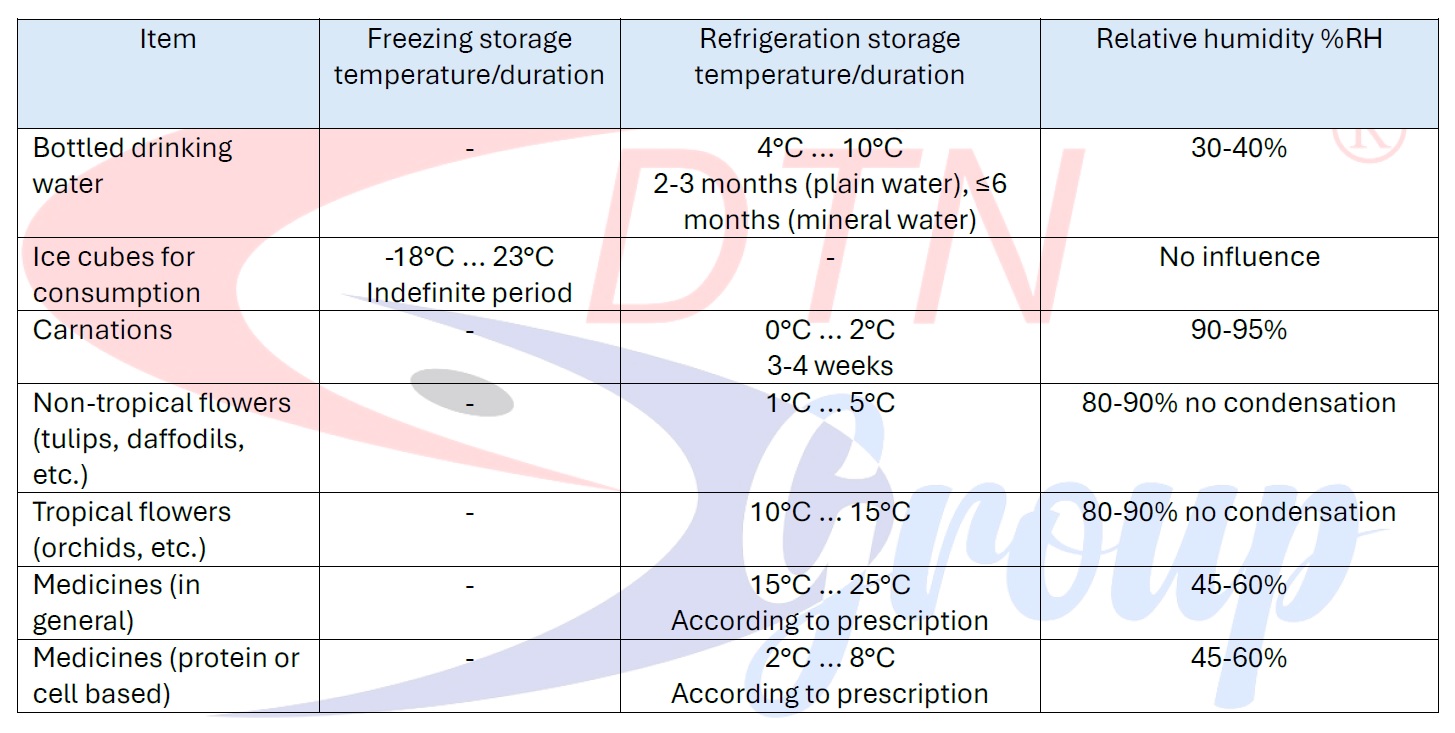
Table 4: Storage temperatures for water, flowers, medicines 
Important notes:
Some of these goods require pre-cooling conditions with forced air in order not to affect the quality of the product (examples: bananas, cherries, Brussels sprouts, cucumbers, grapes, mushrooms, oranges, pumpkins, strawberries, tomatoes) - see López Camelo A.F , FAO, 2004.
In order to reduce costs, users can introduce in the same cold storage facilities fruits and vegetables which are compatible regarding storage temperatures[2]. It is also possible to use the compartmentalization of cold rooms and cold containers in order to store and transport the managed goods at different temperatures.

Temperature and humidity monitoring in cold rooms and refrigerated machines can also be carried out remotely, by means of T-Sentinel technology. This aspect is all the more useful as the monitored temperatures are recorded and archived for subsequent HACCP inspections.
Checking the internal temperatures of food products (such as: cheese, meat) can also be done by inspecting with a digital thermometer equipped with a probe.
Even if some goods are not stored at freezing temperatures, they are susceptible to spoilage if they fall below the minimum optimum temperature threshold. For example, bananas will not be stored below 9°C and peppers will not be stored below 5-6°C.
Fig. 2: Example of peppers with injury from improper cold exposure

Source: López Camelo A.F, FAO, 2004, fig. 58 - symptoms of cold injury are usually small depressed areas (lesions) on the surface of the vegetable which are subsequently colonized by microorganisms
In addition to this, the opposite is also true. If the recommended storage temperature threshold is exceeded, the products enter the spoilage process. For example, the temperature of pork (carcass) must not exceed the threshold of 2°-3°C in cold rooms. And the temperature of beef intended for freezing will not be kept at temperatures of -15°...-10°C. Even in these situations, spoilage can start if the product is stored for a very long time.
Ventilation and positioning of products in cold stores and refrigerated machines are also very important. For example, "inside a forced-air pre-cooling plant, pallets of fruit are arranged to form an aisle. The tops are covered with a cloth leaving both sides exposed to the cold air. The air in the plenum tunnel is removed creating a negative pressure which it forces cold air to pass through the load" (López Camelo A.F , FAO, 2004, fig. 55). Furthermore, in order to minimize the influence of external temperatures in the case of frequent entrances and exits, it is also possible to use heat-insulating PVC curtains for cold rooms in order to minimize thermal shock.
In domestic refrigerators and freezers, where the air environment and ventilation differs from that of cold rooms, the shelf life of food can vary, as different foods are stored in the same space. You can access this list from Food Safety USA in order to check the maximum shelf life of food in home refrigeration equipment.
L. Melinda Stan - Manager Marketing DTN Group
[1] Gross K. C. et all, The Commercial Storage of Fruits, Vegetables, and Florist and Nursery Stocks, United States Department of Agriculture USDA, Agriculture Handbook Number 66, 2016, USA, p. 7-10
[2] See full list in idem., p. 55-57
Sources DTN Group:
Cano-Muñoz G., "Manual on meat cold store operation and management", FAO ANIMAL PRODUCTION AND HEALTH PAPER 92, Food and Agriculture Organization of United Nations, Rome, 1991
Gross K. C. et all, The Commercial Storage of Fruits, Vegetables, and Florist and Nursery Stocks, United States Department of Agriculture USDA, Agriculture Handbook Number 66, 2016, USA
Hadad R., "Cold Storage Chart & Reference Guide", Cornell Cooperative Extension, Cornell University, pp. 1-36
López Camelo A.F., "Manual for the preparation and sale of fruits and vegetables. From field to market", FAO AGRICULTURAL SERVICES BULLETIN 151, Food and Agriculture Organization of United Nations, Rome, 2004
Shan C. et all, "The Effects of Poly-γ-Glutamic Acid on the Postharvest Physiology and Quality of Strawberry cv. Hongyan during Cold Storage", Foods 2023, 12(15), 2944
***, "Cold Food Storage Chart", FoodSafety.gov, accesat pe 12.09.2024
*** " Freezing and refrigerated storage in fisheries", FAO FISHERIES TECHNICAL PAPER - 340, Food and Agriculture Organization of United Nations, Rome, 1994